Buyer's guide
Paracord supplies: the honest buyer's guide
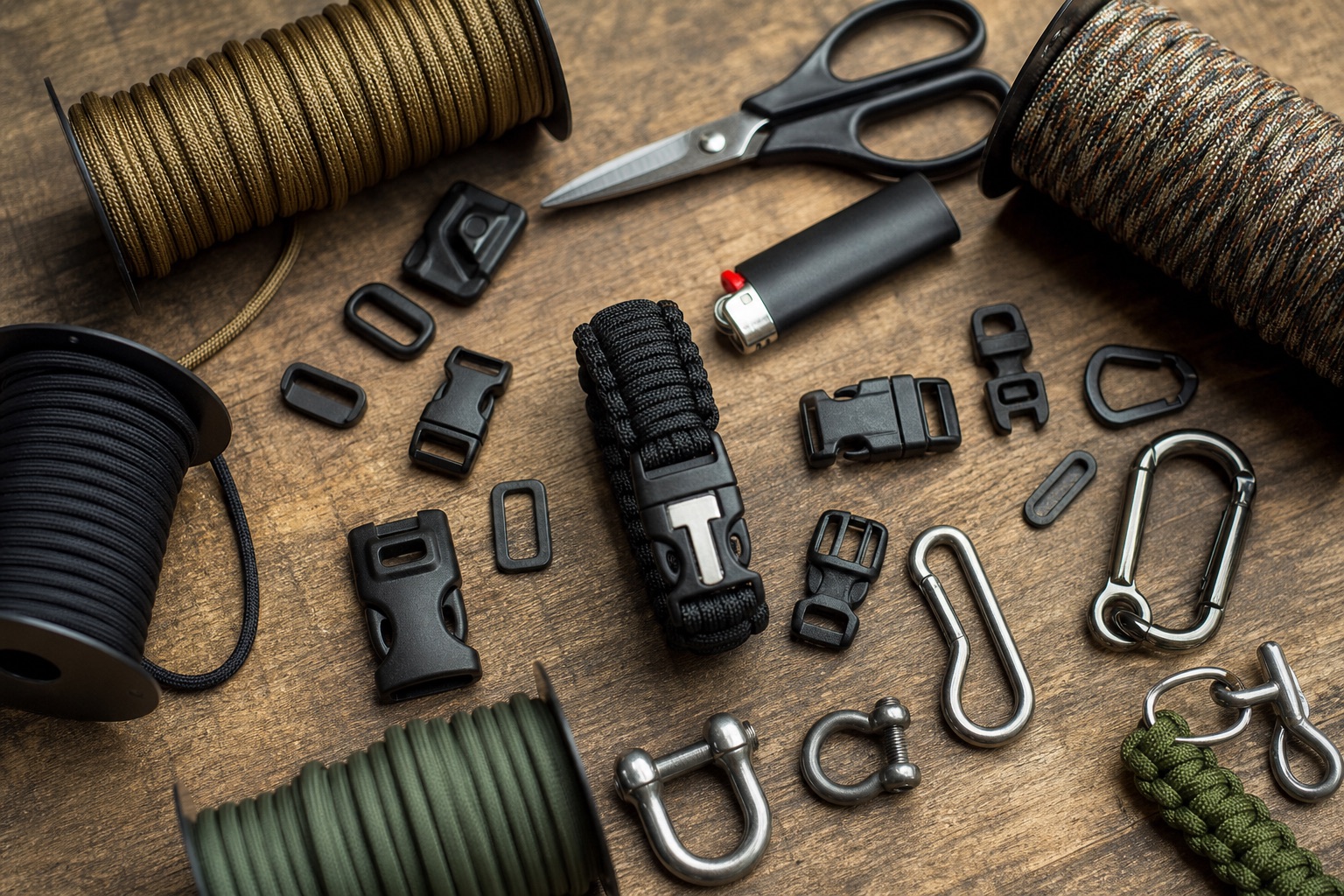
Paracord is cheap, which is exactly why the market is full of cord that is cheaper than it should be. This guide separates the purchases that matter from the ones that merely fill a basket. We link no sellers and take no affiliate money — the criteria are the product.
The cord itself
Buy one 100-foot (30 m) spool of honest Type III 550 in a colour you will actually use — olive drab, black or tan for field gear; something brighter for craft pieces that should be findable. Check three things before the rest: strand count (seven two-ply core strands, stated on the listing), fibre (100 percent nylon, not "nylon blend"), and sheath density (pick count in the description or a sample photo where the weave looks tight, not loose and shiny).
Add a 50-foot spool of micro cord (1.2–1.5 mm) for zipper pulls, lacing and decorative contrast, and — only if you rig tarps or make heavy straps — a spool of Type IV. Full type-by-type guidance is in the sizes reference; the buying version is simple: unbranded 550 sold well below the going rate of reputable nylon is where the disappointment lives.
Tools: four earn their place
- Sharp scissors or a hobby knife — paracord laughs at blunt blades and frays in protest. Sharp cuts melt cleaner (see joining).
- A lighter — the cord's own fastener. A soft flame beats a torch for controlled melts.
- Hemostats or needle-nose pliers — for pulling tight weaves (cobra rows, monkey fist final tightening) and threading cord through buckles.
- A cutting + melting combo tool — a hot-knife or electric rope cutter is the one luxury worth considering once you weave weekly; it fuses as it cuts.
Measuring tape, a permanent marker for cut marks, and a ruler complete the bench. Everything else is decoration.
Hardware: buckles, clips, rings
Bracelets live or die on closures. Our dedicated buckle guide compares single-bar, two-hole and shackle styles; the buying summary: curved side-release buckles in 3/4" or 1" for comfort, steel shackles when the bracelet doubles as cordage you might actually deploy, and screw-tight gates for the multi-tool-and-clip crowd.
For lanyards and key fobs, stock steel gate clips and split rings in two sizes — visible in our lanyard project. For dog collars, buy metal side-release or martingale hardware rated for webbing, never plastic craft buckles; the collar guide explains the welding trick that keeps cord from slipping through hardware.
Spotting fake "mil-spec" in thirty seconds
The three-question test. One — does the listing state core strands and fibre? Two — does a cut-end photo show a dense sheath you cannot push a nail into? Three — is the price plausible for real nylon? If any answer is no, treat it as craft cord and price it accordingly. Mil-spec is a documented standard, not a word: see the comparison.
The starter kit, totalled
| Item | Quantity | Rough budget share |
|---|---|---|
| Type III 550 cord, nylon, 7-strand | 100 ft spool | 40% |
| Micro cord | 50 ft spool | 10% |
| Curved side-release buckles 3/4" | 5-pack | 15% |
| Steel gate clips + split rings | assorted | 15% |
| Hemostats | 1 | 15% |
| Scissors, lighter, marker, tape | already owned | 5% |
That kit finishes your first cobra bracelet, a box knot keychain, a fishtail band and a lanyard, with cord left for repairs. Upgrade only what your projects demand — the cord is the one line item where quality is non-negotiable.
One last shopping habit: buy your first spools in colours you will actually wear. The drawer of every lapsed paracord maker holds the same evidence — neon hanks bought for enthusiasm rather than use. Olive drab, black, tan and one accent colour cover 95 percent of projects and all of the field ones; the exotic palette can wait until the braiding habit has taken hold.