Project · keychains
The box knot paracord keychain
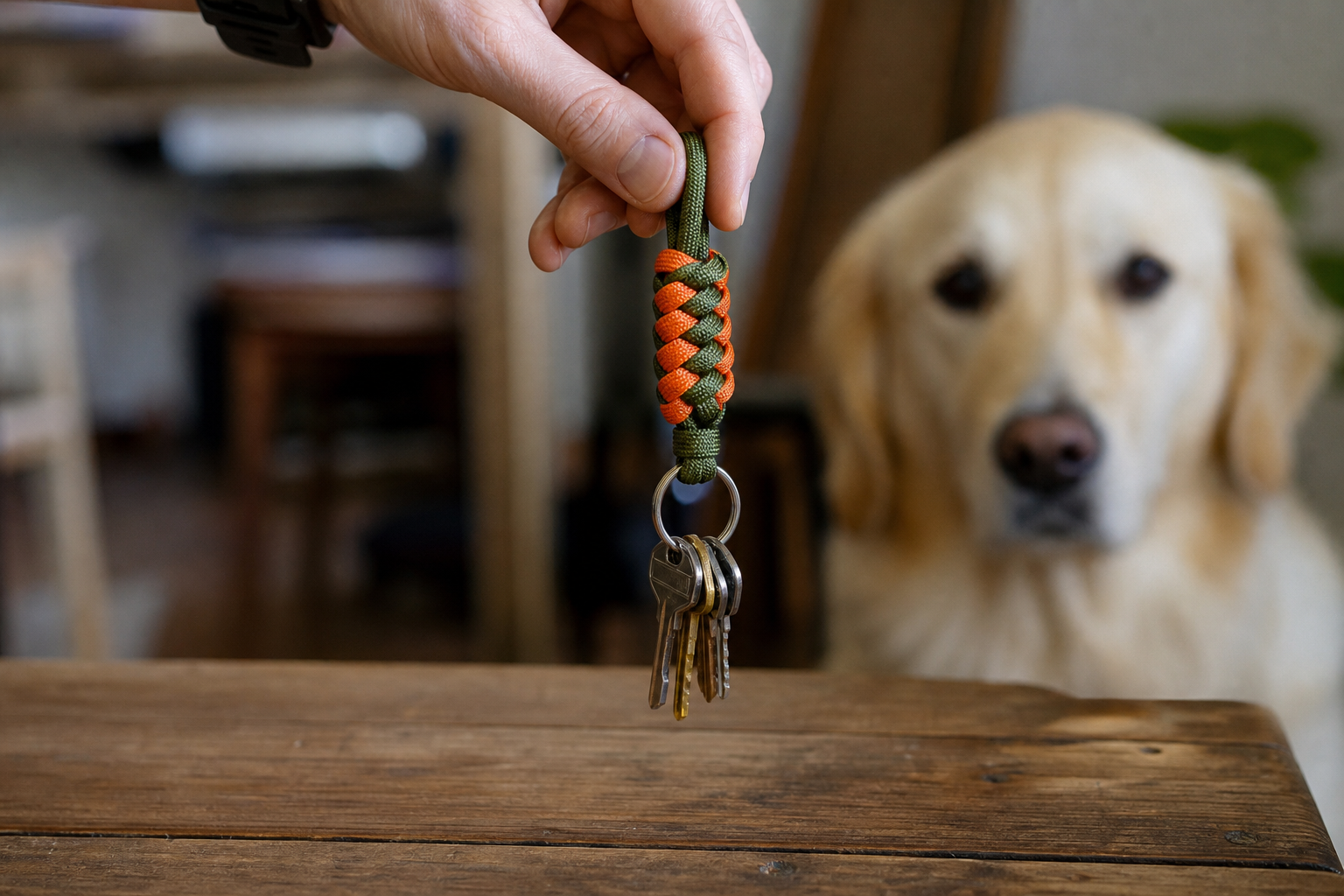
The box knot — the square knot of scouting lanyards, the "scoobie" of summer camps — is the ideal second project after a cobra bracelet. It builds a square, solid chain that survives pocket abrasion for years, needs no core and no buckle, and produces a keychain you will still be using when the keys have changed twice.
Materials
Two lengths of 550 cord about 1.5 m each — two colours make the pattern legible while learning. One split ring or gate clip (see the hardware buying guide), scissors, lighter. Optionally a lanyard knot or a steel ball for a decorative head.
The knot, step by step
Start on the ring
Thread both cords through the split ring and find their centres — or melt-splice your two colours into one long strand and fold it at the ring (the hidden splice from the joining guide). You now have four working ends hanging from the ring.
Lay the cross
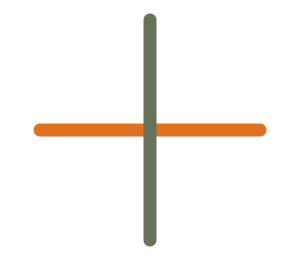
Hold the two cords as a plus sign over your fingers: colour A horizontal, colour B vertical, crossing at the centre below the ring. The vertical cord goes over the horizontal.
Send each end around its neighbour
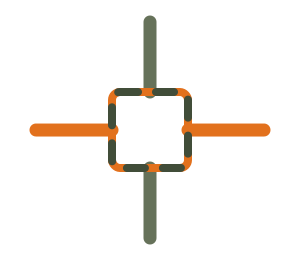
Working clockwise: the top end folds down over the right end; the right end folds left over the bottom; the bottom folds up over the left; the left folds right — and through the loop the top end made when it folded down. Every end passes over one neighbour and under the next: over, under, over, under, round the square.

Tighten square
Pull the four ends outward, evenly, in pairs — left with right, then top with bottom. The first knot closes into a small square box snug under the ring. Do not twist the cords; each face of the square should show one colour cleanly.
Repeat and finish
Re-lay the cross and repeat — same clockwise discipline, every knot identical, until the chain reaches length (8–10 cm suits pockets). Finish with a lanyard knot in the four ends, or a simple overhand cluster, cut to 5 mm, melt and press flat. Add the keys.
The classic failure: reversing direction mid-chain — one knot counter-clockwise and the box twists ninety degrees. If your square starts rotating, you skipped an "over" somewhere; un-pick the last knot rather than fighting the one above it. Slow is fast with the box knot: it has exactly four moves and they never change.
Variations
- Round box (spiral) — same four moves, but always start each knot from the same end offset by one position: the square becomes a firm cylinder, a favourite for zipper pulls on lanyards.
- Two-colour split — one colour for the lengthwise ends, one for the crosswise: the box faces alternate like a checkerboard.
- Core-filled box — lay a straight centre cord inside the weave for a stiffer, chunkier chain that carries extra cordage like a miniature survival bracelet.
Why this project pays rent
Keys are the most abrasive object in a pocket, and the box chain is dense enough to shrug it off for years. The same knot, in micro cord, scales down into zipper pulls for packs and jackets; scaled up in Type IV it becomes a grab handle. Few techniques in this craft travel as far from one afternoon of practice.
It is also the best teacher in the craft's beginner tier. The box knot has no core to hide mistakes and no buckle to fuss with — every error is visible one knot later, which is exactly the feedback loop a new maker needs. Tie a 30 cm chain one evening and you will emerge with clean cord control, the melt-and-press finish mastered, and the confidence to attempt the monkey fist that looked impossible from the far side of the box knot.